Train for decades, not this week
Pick partners and an intensity that let you come back tomorrow. Staying on the mat for years beats winning one round.
Cookies & privacyYour privacy choices
We use essential cookies to run this site. Analytics, personalization and advertising cookies stay off unless you accept them. Privacy Policy
We use cookies for site features, analytics, personalization and advertising. Some US state laws call this “selling” or “sharing” personal data. Choose Reject to opt out, now or any time. Privacy Policy
Martial arts & grappling
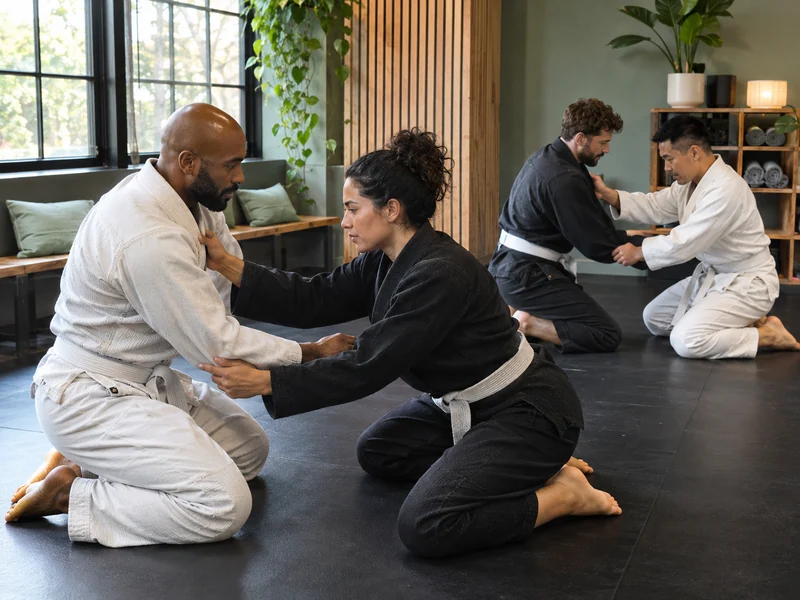
Brazilian jiu-jitsu is a core part of how David West trains on Long Island. It's hard, humbling and social, which is why so many adults stick with it. Here's what grappling gives a busy professional, how to start and how to keep training for years.

Why it matters
Few activities train your body, your focus and your character at the same time. Grappling for adults does all three, and it comes with a built-in community.
David's approach
Jiu-jitsu rewards the people who keep showing up. These are the principles David trains by.
Pick partners and an intensity that let you come back tomorrow. Staying on the mat for years beats winning one round.
Tapping is how you learn. Tap before a choke or joint lock gets dangerous, and expect your partners to do the same.
Clean reps of one technique build skill. Live rounds test it. Most of the learning happens in the drilling.
Lifting and mobility work make grappling feel easier and help you stay on the mat. See the strength guide.
How to start
Jiu-jitsu academies are easy to find on Long Island. Starting well takes a little more thought.
Visit a few. Look for a clean mat, a real fundamentals class and coaches who watch rounds closely. Ask about a trial class.
Go to beginner classes consistently. Learn to escape, hold position and breathe before you worry about submissions.
Tell partners you're new, pick calm ones and go at a pace you can control. Tap early.
After each class, write down one technique and one question. A training app like OpenMat makes logging sessions easy.
Mistakes to avoid
The fastest way off the mat is an injury or burnout, not a hard class. Avoid these.
Going all out every round leads to injuries and burnout. Most rounds should be technical and playful.
Pride recovers quickly. An injured elbow or shoulder can keep you off the mat for a long time.
Necks, knees and backs take a lot in grappling. Warm up properly and keep up your mobility work.
Get pain checked by a clinician, then train around it with their guidance. See the injury recovery guide.
In David's network
Brands David works with that serve the grappling world, from your training log to how you move to private instruction.
Martial arts
Training app and business platform for jiu-jitsu and MMA: session logging, training partners, coaching tools and academy management.
Movement & wrestling
Functional movement coaching built on wrestling and jiu-jitsu fundamentals, so grapplers move better and train longer.
Training & executive protection
Martial arts instruction, private training and executive protection services.
Run an academy? David can introduce you to other owners, coaches and landlords. Request an introduction.
Keep reading
How David approaches lifting and conditioning, and a simple way to start.
Training around an injury, with a clinician in charge of the plan.
Sauna, cold plunge and the recovery routine around them.
Questions
Many adults start in their thirties, forties and beyond. Choose an academy with a strong fundamentals program, train at a controlled pace and talk to your doctor first if you have health concerns.
No. Classes build fitness as you go. Basic strength and mobility help, so pairing jiu-jitsu with a simple lifting routine is a good idea.
Both teach the same core ideas. The gi adds grips and tends to slow things down, which many beginners find helpful. No-gi is faster and closer to wrestling. Try both and keep doing the one you enjoy.
At David's events. His Long Island morning sessions and his founder events are built for people who train, and every workout is optional. Join the invite list to hear about the next one.
Train together
Founders and professionals who grapple, lift and run meet at David's events across Long Island and Manhattan. Join the invite list to hear about the next one.
This is David's personal approach and general information, not medical advice. Talk to a qualified professional about your own health.